



register for newsletter
get latest company news

The global photovoltaic industry is entering a new stage of technological competition in 2026. TOPCon, Back Contact (BC), and Heterojunction (HJT) technologies are advancing along different development paths, with manufacturers focusing on higher module efficiency, lower silver consumption, improved manufacturing processes, and better production economics.
TOPCon continues to maintain a strong position in commercial solar cell manufacturing. BC technology is setting new benchmarks in commercial module efficiency, while HJT manufacturers are exploring improvements in metallization, thinner wafers, and advanced interconnection technologies.
Meanwhile, innovations such as Zero Busbar (0BB), multi-cut cell layouts, gapless module designs, and new encapsulation materials are changing the way solar modules are manufactured.
These developments are important not only for solar cell manufacturers but also for companies investing in solar module production facilities. Changes in cell structures and module designs can directly influence equipment selection, production processes, automation requirements, and future factory upgrade plans.
This article reviews the latest developments in TOPCon, BC, and HJT technology in 2026 and examines what these changes mean for the solar module manufacturing industry.
TOPCon (Tunnel Oxide Passivated Contact) remains one of the most important technologies in the global photovoltaic manufacturing industry.
Its established industrial ecosystem, competitive manufacturing costs, and relatively mature production processes have supported its widespread commercial adoption.
However, TOPCon development is not standing still. Manufacturers are continuing to improve cell structures, surface passivation, metallization, and manufacturing equipment to achieve higher efficiency and reduce production costs.
The commercial performance of TOPCon modules has continued to improve.
According to the November 2026 TaiyangNews TOP SOLAR MODULES listing, JA Solar's TOPCon module reached a reported efficiency of 24.1%, with a rated power of 650 W.
TOPCon also had the largest representation among the top ten products in the listing, accounting for six of the ten positions.
This demonstrates that TOPCon remains highly competitive in the commercial high-efficiency module market.
The development of TOPCon is increasingly focused on improving existing manufacturing processes rather than relying on a completely new cell architecture.
Manufacturers are working on several areas:
Improving surface passivation to reduce carrier recombination.
Optimizing rear-side contact structures.
Reducing electrical losses during metallization.
Improving laser processing accuracy.
Enhancing cell edge passivation.
Reducing silver consumption while maintaining electrical performance.
These improvements can help manufacturers increase cell and module performance without abandoning the established TOPCon production ecosystem.
One important direction in TOPCon development is the optimization of rear-side structures.
Rear polyfinger designs and improved edge passivation are receiving attention because they can help reduce electrical losses and improve cell performance.
These developments also create new requirements for manufacturing equipment.
The 2026 TaiyangNews Cell Production Equipment Market Survey identifies rear polyfingers, laser processing, and edge passivation as important areas in next-generation TOPCon manufacturing.
Equipment suppliers are therefore focusing on more precise processing, improved production throughput, and better process consistency.
For manufacturers, the objective is not simply to achieve a higher laboratory efficiency. The improvements must also be suitable for stable industrial production.
Silver paste is an important material in conventional solar cell metallization.
As manufacturers continue to pursue lower production costs, reducing silver consumption has become a significant industry priority.
New metallization approaches include:
Silver-lean screen printing.
Improved finger and busbar designs.
Copper-based metallization solutions.
Alternative conductive materials.
Optimized printing processes.
At the November 2026 TaiyangNews High-Efficiency Solar Technologies Conference, researchers from UNSW discussed pathways to reduce silver consumption in TOPCon cells to below 2 mg/W through silver-lean screen printing.
This remains a technology development target rather than a universal commercial manufacturing level.
The direction is nevertheless important: future solar cell competitiveness will depend not only on conversion efficiency but also on material consumption and manufacturing costs.
TOPCon improvements are gradually influencing the requirements of downstream module manufacturing.
For solar module factories, important considerations include:
Cell handling: Maintaining stable transfer and positioning as wafer and cell designs evolve.
Stringing: Ensuring that interconnection methods are compatible with the selected cell structure and metallization.
Layup: Maintaining accurate cell spacing and alignment.
Lamination: Matching encapsulation materials and process parameters to the module design.
Testing: Maintaining reliable EL inspection and electrical performance testing.
The key point is that a TOPCon module production line must be configured according to the actual cell and module specifications, rather than simply being described as a standard production line.
Back Contact (BC) technology is one of the most closely watched developments in the photovoltaic industry in 2026.
Unlike conventional front-contact solar cells, BC technology places electrical contacts on the rear side of the cell.
This structure removes conventional front-side metal grid lines, allowing more sunlight to reach the active surface.
BC technology has attracted growing attention because of its high-efficiency potential, distinctive module appearance, and opportunities for further cell structure optimization.
One of the most important commercial developments in 2026 is the progress of BC modules.
According to the November 2026 TaiyangNews TOP SOLAR MODULES listing:
AIKO's BC module reached 25% efficiency, with a rated power of 675 W.
LONGi's BC module also reached 25% efficiency.
Both companies shared the leading position in the commercial module efficiency ranking.
This marked an important milestone for commercially available crystalline silicon solar modules.
It is important to distinguish commercial module efficiency from laboratory solar cell efficiency. The 25% figure refers to the module-level efficiency reported in the TaiyangNews commercial product listing.
The development demonstrates that BC technology is moving beyond research achievements and becoming increasingly competitive in the commercial high-efficiency module market.
There are several reasons why BC technology is attracting investment and research attention.
Higher front-side light utilization
By moving electrical contacts to the rear side, BC cells eliminate conventional front-side grid shading.
High-efficiency potential
The rear-contact structure provides opportunities for optimizing electrical contacts and improving cell performance.
Improved module appearance
The front surface of a BC module has a cleaner appearance, which is attractive for residential rooftops and other applications where visual appearance matters.
Further material optimization
BC manufacturers are also exploring new metallization approaches and alternative conductive materials to reduce production costs.
These advantages make BC an important technology direction, particularly in the premium solar module market.
BC cells have a different electrical contact structure from conventional front-contact cells.
Their manufacturing processes require careful control of rear-side patterning, electrical contact formation, and passivation.
Important process areas include:
Rear-side patterning and contact formation.
Laser processing.
Surface preparation and passivation.
Metallization.
Electrical performance testing.
Process alignment and quality control.
The 2026 TaiyangNews equipment survey highlights the growing importance of laser processing and wet chemistry in BC cell manufacturing.
An important observation is that BC production is not simply about adding one new machine. The coordination between different manufacturing steps and the stability of the entire process flow are equally important.
The development of BC technology also has implications for downstream module assembly.
Manufacturers need to consider whether their equipment is compatible with the specific BC cell design and interconnection method.
The main areas requiring attention include:
Cell handling and positioning.
Stringing and electrical interconnection.
Cell alignment during layup.
Encapsulation material selection.
Lamination process parameters.
EL inspection and electrical testing.
For investors planning a new solar module factory, it is important to confirm BC compatibility with equipment suppliers before purchasing a production line.
A conventional TOPCon module assembly configuration should not automatically be assumed to support every BC module design.
Heterojunction Technology (HJT) combines crystalline silicon with thin-film silicon-based layers to create a specialized solar cell structure.
HJT is known for its high-efficiency potential, good temperature characteristics, and relatively low-temperature manufacturing processes.
Although HJT has not achieved the same level of manufacturing scale as TOPCon, it continues to attract attention from manufacturers seeking alternative high-efficiency technologies.
In 2026, HJT development is increasingly focused on material optimization, thinner wafers, and more economical metallization.
According to the November 2026 TaiyangNews commercial module listing, Risen Energy's HJT module reached:
Rated power: 740 W.
Module efficiency: 23.8%.
This made it the highest-power product in that particular listing.
However, module power and module efficiency are different performance indicators.
Module power is affected by the module's physical area and design, while efficiency measures how effectively the module converts incident sunlight into electricity.
Therefore, a higher wattage rating does not necessarily indicate a higher conversion efficiency.
Risen's 740 W product demonstrates HJT's competitiveness in high-power module development.
One direction attracting renewed attention in HJT development is the use of thinner silicon wafers.
Reducing wafer thickness can help reduce silicon material consumption and improve the economics of cell manufacturing.
However, thinner wafers also create manufacturing challenges.
They are more sensitive to mechanical stress and breakage, making wafer handling and transportation increasingly important.
Manufacturers need to pay attention to:
Wafer handling systems.
Transfer stability.
Mechanical stress control.
Breakage rates.
Process consistency.
These requirements can influence the design of wafer processing equipment and the overall production line.
Metallization is another important area in HJT development.
HJT cells traditionally rely on low-temperature metallization processes, which creates specific requirements for conductive materials.
Silver-coated copper paste and other alternative metallization solutions are being developed to reduce silver consumption while maintaining electrical performance.
The TaiyangNews 2026 Cell Production Equipment Market Survey reports that HJT silver-coated copper paste solutions have reached mass-production application, with reported silver content reductions in certain implementations.
This is an important step toward reducing HJT manufacturing costs.
However, different materials and process configurations may produce different results. Manufacturers need to evaluate electrical performance, reliability, and production stability before adopting a new metallization solution.
Zero Busbar (0BB) technology is another important development associated with HJT module manufacturing.
Traditional module interconnection uses busbars to collect and transfer electrical current.
The 0BB approach reduces or eliminates conventional busbars and uses alternative interconnection structures.
Potential advantages include:
Lower silver consumption.
Improved light utilization.
Optimized electrical interconnection.
Opportunities to reduce module manufacturing costs.
The development of 0BB is particularly relevant to HJT because of its relationship with advanced metallization and interconnection processes.
For module manufacturers, however, 0BB is not simply a matter of removing busbars. The stringing process, conductive materials, connection methods, and quality inspection procedures must all be compatible with the selected module design.
While TOPCon, BC, and HJT are usually discussed at the solar cell level, many important improvements are also taking place during module assembly.
Module manufacturers are exploring different ways to increase active area, reduce electrical losses, and lower material consumption.
Three developments deserve particular attention.
0BB is changing traditional solar cell interconnection methods.
By reducing or eliminating conventional busbars, manufacturers aim to improve material utilization and optimize electrical performance.
However, 0BB requires compatible interconnection processes and equipment configurations.
Important considerations include:
Stringing technology.
Interconnection materials.
Cell positioning accuracy.
Connection reliability.
Process temperature and pressure.
Quality inspection.
As 0BB technology develops, manufacturers need to evaluate the compatibility of existing stringing equipment with their target module design.
Multi-cut technology divides a full solar cell into smaller pieces before module assembly.
The purpose is to optimize electrical current characteristics and reduce certain resistive losses.
It can also help manufacturers develop different module layouts and power configurations.
However, smaller cell pieces require accurate positioning and careful handling.
For production lines, this places greater demands on:
Cell transfer systems.
Cutting accuracy where cutting is performed in-line.
Stringing equipment compatibility.
Automatic layup precision.
Defect detection.
The exact requirements depend on the cell size, cutting method, and module layout.
Gapless module designs aim to reduce the spacing between adjacent cells.
By increasing the effective active area of the module, manufacturers can make better use of the available module surface.
However, reduced cell spacing requires more precise manufacturing.
Automatic layup systems must maintain consistent positioning, while encapsulation and lamination processes must be suitable for the selected module structure.
Gapless designs are therefore closely related to equipment precision and process stability.
The development of TOPCon, BC, and HJT is influencing the requirements for solar module manufacturing equipment.
A production line that performs well with one cell technology may require adjustments when the manufacturer changes its cell structure, interconnection method, or module design.
For investors planning new solar module factories, equipment selection should therefore be based on actual manufacturing requirements.
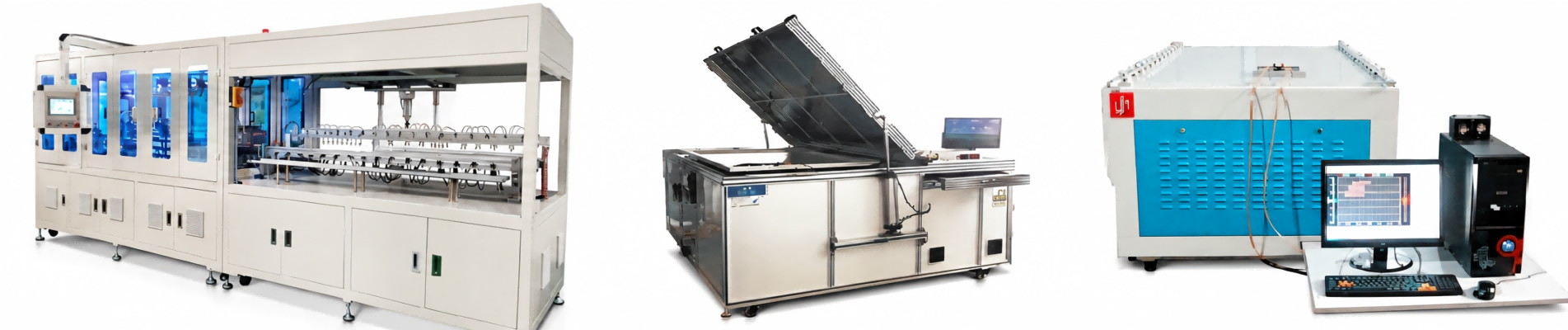
The stringing machine is one of the most important pieces of equipment in a solar module production line.
It connects solar cells through electrical interconnection materials to form cell strings.
Different cell technologies and interconnection designs may require different configurations.
For example:
Conventional TOPCon modules may use established soldering and interconnection processes.
HJT modules may require low-temperature interconnection solutions.
BC modules require processes compatible with their rear-contact structures.
0BB modules may require specialized stringing and connection methods.
Before purchasing a stringing machine, buyers should confirm supported cell technologies, cell dimensions, interconnection materials, and process requirements.
Automatic layup machines arrange cell strings and other module materials according to the required module design.
As module structures become more diverse, accurate positioning becomes increasingly important.
This is particularly relevant to:
Multi-cut cell layouts.
Gapless module designs.
Different cell dimensions.
Advanced interconnection structures.
Stable automatic layup helps reduce positioning errors and maintain consistent manufacturing quality.
Lamination is a critical stage in solar module manufacturing.
The process combines the glass, encapsulation materials, solar cell strings, and backsheet or rear glass into a complete module structure.
Different cell technologies and module designs may require different lamination process parameters.
Manufacturers should consider:
Encapsulation material compatibility.
Temperature control.
Pressure control.
Process duration.
Module dimensions.
Product structure.
The laminator should be selected according to the actual module design and materials, rather than only its nominal production capacity.
As solar module structures become more advanced, quality inspection remains essential.
EL testing helps identify internal defects such as cell cracks and certain electrical abnormalities.
Solar module IV testing measures important electrical performance parameters, including:
Maximum power.
Open-circuit voltage.
Short-circuit current.
Maximum power point voltage.
Maximum power point current.
Fill factor.
For a modern production facility, reliable testing equipment is important for maintaining product consistency and identifying manufacturing problems.
In October 2026, China's Ministry of Industry and Information Technology released a proposed update to its photovoltaic manufacturing industry standards.
The proposal includes higher average conversion efficiency requirements for new and expanded solar cell and module production facilities.
For new and expanded production lines, the proposed minimum average cell efficiencies include:
| Technology | Proposed cell efficiency |
|---|---|
| TOPCon | 26.2% |
| HJT | 26.0% |
| BC | 26.6% |
The proposed average module efficiency requirements are:
| Technology | Proposed module efficiency |
|---|---|
| TOPCon | 24.2% |
| HJT | 24.0% |
| BC | 24.4% |
These figures are from the proposed standards and should not be interpreted as requirements that have already entered into force.
The proposal reflects the industry's growing focus on manufacturing quality, technological progress, and the need to address excessive production capacity.
For equipment suppliers and factory investors, this development is worth monitoring.
Future production line investments may need to consider not only current product specifications but also evolving manufacturing standards and efficiency requirements.
The continued development of TOPCon, BC, and HJT creates both opportunities and challenges for investors planning solar module manufacturing projects.
Choosing a production line is no longer simply a matter of comparing equipment prices and annual production capacity.
Several factors need to be evaluated before making an investment.
The first step is to determine which cell technology the factory intends to use.
Will the production line focus on TOPCon modules? Will it manufacture HJT or BC products? Does the project require compatibility with multiple module designs?
These decisions affect equipment selection, production processes, and investment planning.
Module dimensions and power specifications directly influence equipment configuration.
Buyers should provide the following information:
Module length and width.
Cell dimensions.
Cell arrangement.
Target module power.
Glass and encapsulation material specifications.
Module structure.
These details allow equipment suppliers to evaluate whether the proposed production line can meet the intended manufacturing requirements.
Production capacity should be considered together with actual manufacturing efficiency.
Important factors include:
Equipment operating speed.
Automation level.
Material handling systems.
Production line layout.
Equipment synchronization.
Product changeover requirements.
Future expansion possibilities.
A production line with high nominal equipment speed does not necessarily guarantee high actual factory output.
The entire manufacturing process needs to operate in a coordinated and stable manner.
Solar module technology continues to evolve.
Investors should discuss future upgrade possibilities with equipment suppliers before purchasing a production line.
Important questions include:
Can the stringing machine support the intended cell technologies?
Can the layup system accommodate different cell arrangements?
What changes are required for 0BB production?
Can the laminator support the planned encapsulation materials?
Which equipment may require modification if the module design changes?
A clear understanding of these questions can help investors reduce future modification costs and avoid unnecessary equipment investment.
The development of TOPCon, BC, and HJT demonstrates that the photovoltaic industry is moving toward more diversified high-efficiency cell technologies.
TOPCon continues to benefit from its established manufacturing ecosystem and strong commercial presence. BC is setting new benchmarks in commercial module efficiency. HJT is advancing through improvements in materials, metallization, wafer handling, and interconnection technology.
At the same time, 0BB, multi-cut cells, and gapless module designs are changing how solar modules are assembled.
These developments suggest that future competitiveness will depend on more than simply adopting a particular cell technology.
Manufacturers will also need to focus on:
Higher production efficiency.
Lower material consumption.
Stable manufacturing quality.
Flexible equipment configurations.
Reliable product testing.
Long-term equipment upgrade possibilities.
For companies planning new solar module factories, the most important decision is to select a production line that matches their target market, module specifications, manufacturing technology, and long-term investment strategy.
Looking for a Solar Module Production Line for Your Manufacturing Project?
SUPO provides solar module production line solutions for manufacturers planning new factories or upgrading existing facilities.
Whether you are considering a semi-automatic production line or a fully automatic manufacturing solution, our team can help you evaluate production capacity, module specifications, equipment configuration, and automation requirements.
Contact SUPO to discuss your solar module manufacturing project.
get latest company news
Scan To Wechat