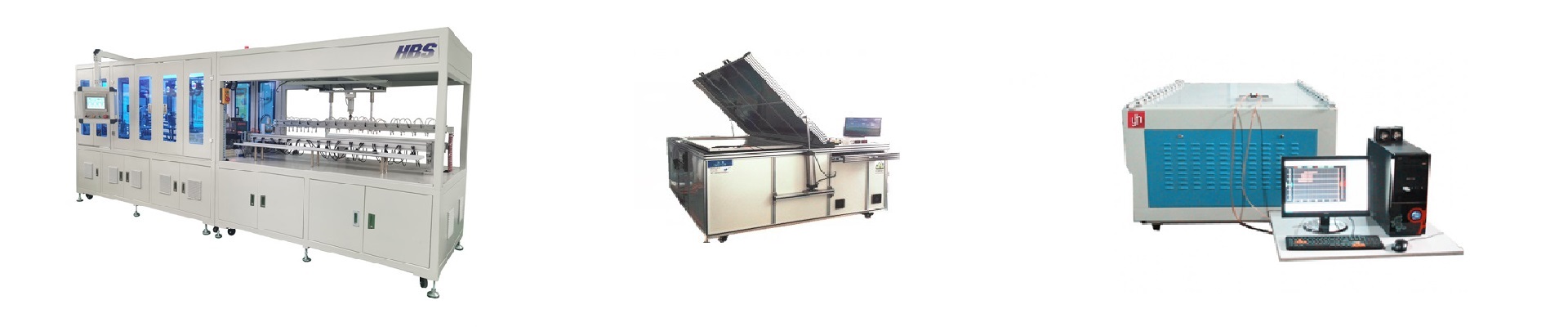
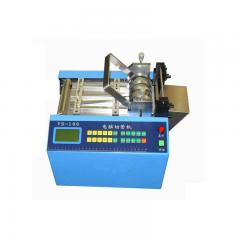
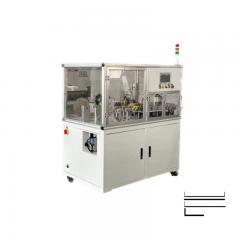
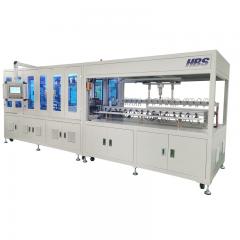
Solar Cells Automatic Tabber Stringer
Model: HBS-SP1800

Specification
|
Net capacity
|
1250-1400 cells/hour
|
|
Cell size
|
30-166*166mm
|
|
Cell thickness
|
160um~300um
|
|
Busbar
|
5BB 6BB 9BB change over time 0.5H(feature)
|
|
Ribbon width
|
0.6mm-1.5mm
|
|
Busbar thickness
|
0.15-0.21mm
|
|
Ribbon position
|
Less than 0.1mm shift
|
|
Flux coating
|
Sunk auto coating flux
|
|
Soldering method
|
Infrared heating
|
|
Breakage rate
|
≤0.1%(A Grade Solar Cell)
|
|
String length
|
2100mm(2-12pcs)
|
|
Length tolerance
|
±0.5mm
|
|
Straightness tolerance
|
±0.5mm
|
|
Cell gap
|
0.8-30mm(adjustable)
|
|
Cell position
|
Mechanic Position
|
|
Cell string transmission
|
Teflon transmitation belt, driven by servo motor
|
|
Cell defect detection type
|
crack/cold welding/cell reveral /surface stain by Eye Visual
|
|
Layup method
|
Automatic layup/manual layup
|
|
HMI
|
Integrated touch screen IPC with cantilever operation box and English/Chinese interface
|
|
Uptime
|
≥95%
|
|
Electric system
|
PLC plus servo system
|
|
Power
|
50-60Hz/AC380V / 3 phase 5 lines
|
|
CDA pressure
|
06-0.8MPa
|
|
CDA consumption
|
500 liters / min
|
|
Dimension
|
5000*1390*2050mm(L*W*H)
|
|
Weight
|
2100kg
|
Key Component List
|
PN
|
Name
|
Brand
|
|
1
|
PLC
|
Keyence(Japan)
|
|
2
|
Controller
|
Panasonic
|
|
3
|
LCD Screen
|
Weinview
|
|
4
|
Linear system
|
Hiwin
|
|
5
|
Servo Motor
|
Panasonic
|
|
6
|
Cylinder
|
SMC+AirTAC
|
|
7
|
Solenoid Valve
|
SMC+AirTAC+Pneulead
|
Key Features and Advantages of the Automatic Solar Cell Tabber Stringer
1. High Production Efficiency
The Automatic Solar Cell Stringer is designed to automate the solar cell interconnection process, including cell feeding, ribbon handling, soldering, and string transfer. Automated operation helps reduce manual handling, improve production efficiency, and support continuous PV module manufacturing.
2. Precise Cell Interconnection and Soldering
The machine performs precision ribbon positioning and soldering to connect individual solar cells into complete cell strings. Accurate alignment and consistent soldering help establish reliable electrical connections and maintain the quality of solar cell interconnection during PV module assembly.
3. Compatibility with Different Solar Cell Configurations
Designed for photovoltaic module manufacturing, the solar cell tabber stringer can be configured to accommodate different solar cell sizes, busbar layouts, and interconnection ribbon specifications, depending on the machine configuration. This allows manufacturers to adapt production processes to different PV module designs and cell technologies.
4. Adjustable Production Parameters
Depending on the machine configuration, relevant production parameters can be adjusted to meet different solar cell and module manufacturing requirements. These may include ribbon positioning, soldering parameters, cell spacing, and string layout, helping manufacturers adapt the equipment to different production specifications.
5. Consistent Soldering Quality and Process Control
Stable soldering conditions and controlled ribbon positioning are important for reliable solar cell string manufacturing. The machine supports consistent cell interconnection by controlling key process parameters throughout the tabbing and stringing process, helping reduce soldering-related defects and maintain the quality of finished cell strings.